
Credit : Chintan Nedariya and team played a key role building UI/UX for BEMRR .
BEMRR is a highlights app for young cricketers built on a strange bet: show a kid less, and he learns more. Add a coach’s voice to the right swing, let friends cheer, and something else happens too — a thirteen-year-old walks into under-15 trials already seen.
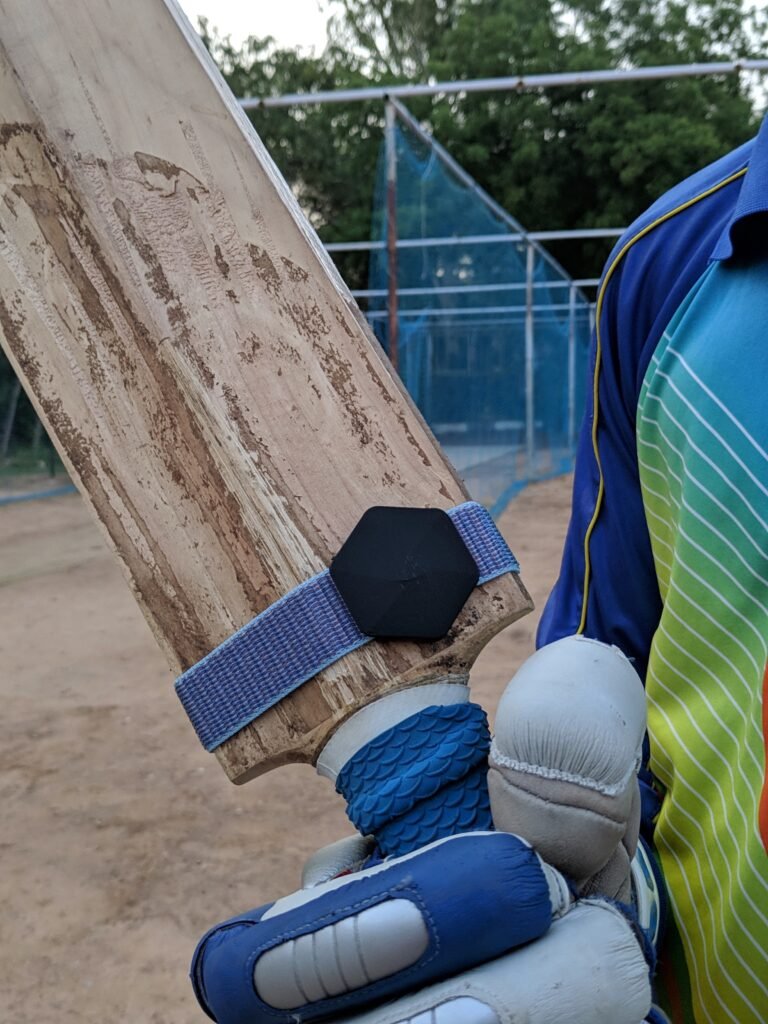
It’s a Tuesday evening at the nets. A boy clips a small sensor to the top of his bat handle, props a phone on a stand outside the net, and forgets both exist. Over the next two hours he faces around two hundred balls. Some are edged, some are missed, a handful are middled so cleanly the whole academy hears it.
When he walks off, pads still on, the app shows him three videos.
Not two hundred. Not a dashboard. Not a graph of bat speed over time. Three short clips of his best swings, picked by the sensor, ready to watch shoulder-to-shoulder with his coach before he’s even taken his gloves off.
Everything about BEMRR follows from that one act of restraint.
Kids are not data scientists
Sports sensors have a default personality, inherited from fitness trackers: measure everything, display everything, benchmark everything. Eleven metrics per shot. Session comparisons. Progress graphs. It’s a design language built for adults who enjoy auditing themselves — and it collapses completely when the user is nine years old, holding a bat, standing in a net where a screen has no business being.
A child at practice doesn’t want to read about their batting. They want to see it. So BEMRR’s founding rule is simple: data never appears as itself. It appears only as a moment. The sensor still measures everything — swing path, contact, repeatability — but all of that intelligence is spent behind the scenes, deciding which few seconds of video deserve to exist. What reaches the child is a clip: their own cover drive, a faint trail tracing the bat’s arc, one word underneath. Clean.
A chart asks a kid to translate. A clip lets him watch himself get it right.
Why only three? Data told us kids Re-watch — A lot.
The signal came before the principle. When we logged how kids used early clips, one behaviour dwarfed everything else: they didn’t scroll, they re-watched — the same good swing, over and over. So we designed for the thing they already did. Three clips, chosen well, get played to death; a feed of two hundred gets abandoned in a minute.
It fits what every good coach already knows: attention is the scarcest thing at a cricket academy. After a two-hour session, a child’s mind is a small cup. Three clips fill it. Thirty spill it. Coaches have worked this way forever — one cue at a time, one thing to feel this week — and BEMRR just builds that wisdom into the product’s bones. By refusing to show the other 197 swings, the app never drains the cognition it’s supposed to feed. Nothing to scroll, nothing to audit, nothing to feel behind on.
And this is why the number is small enough to matter: three clips is small enough to re-watch — which the data told us is the whole point. A kid will play his best straight drive ten times on the bus home, scrubbing it back and forth like a favourite song. That’s not screen time. That’s mental rehearsal of the correct pattern, disguised as pride.
Because the app only ever surfaces the best swings, it celebrates what’s right by design. Faults never come through the front door. They arrive only when a coach chooses to show them — which brings us to the feature we’re proudest of.
One tap, five seconds: the coach’s voice
Here’s the problem with every coaching app before this one: it asked the coach to do more. More tagging, more charts, more reports. A coach running four nets and forty kids has no spare hands and no spare evening.
BEMRR asks for one tap.
When a swing deserves a word, the coach taps once — phone in pocket — and says five seconds out loud, the way coaches always have: “Yes. That’s the elbow. That one.” The app pins that audio to the exact swing the sensor just recorded. Nothing else changes about the session.
But something changes at home. When the child watches tonight’s reel, that clip plays with the coach’s voice over it. The praise lands twice — once live at the net, once again on the sofa, and then every time the clip is replayed. The coach’s words, in the coach’s vocabulary, permanently welded to the precise moment they were about. No app before this let a coach annotate a swing without breaking stride. Ours lets him do it without breaking eye contact.
The clip carries the coaching
This is where the coach’s burden actually drops. He doesn’t write session reports — the reel is the report, and it lands in the family’s chat automatically. He doesn’t field “how is my son doing?” at the gate — the parents watched him middle three on Tuesday, with the coach’s own voice confirming it. And when the coach does want to teach a fault, he doesn’t lecture. He pins two clips side by side — March’s swing next to tonight’s — and attaches one question: “Watch both. What’s different?”
Then the most important thing in the whole system happens: the kid comes to Thursday’s session with the answer, or with a better question. “Coach, why does my bat come down from there?” Curiosity has reversed the direction of coaching. The coach stops pushing corrections at forty kids and starts answering questions from kids who arrived already wondering. Anyone who has taught anything knows which of those two modes actually works.
Friends who cheer, not a ladder to climb
BEMRR has a social layer, and it will never contain a leaderboard. The moment bat speed becomes a rank, every child in the academy starts slogging for the sensor instead of playing the ball.
Instead, friends get a gallery. Each week, everyone’s best clip appears in the group reel. Reactions are cricket-native — a raised bat, not a thumbs-up. Challenges travel as clips: Arjun posts his straight-drive drill, you answer with yours. The loop is watch, try, clip, share — encouragement in, comparison out. Kids stay curious about each other’s games instead of anxious about each other’s numbers.
The reel that made a selection
Aarav is thirteen. For five months, his coach’s one-tap habit quietly built an archive: the March sessions where the bat came down crooked from gully, the June evening when the high elbow finally clicked — with the coach’s voice on it, “that’s the one, Aarav” — and the August nets where the clean strikes came four to an over.
District under-15 trials give a boy six balls to show a selection panel who he is. Six balls to represent five months. It’s the oldest unfairness in junior cricket: the kids who get picked are usually the kids who happened to get seen.
So before trials, Aarav’s coach did something that took him ninety seconds — because the app had already done the rest. He shared Aarav’s improvement reel with the panel: March next to August, three clips, one voice note. The selectors watched a minute and a half of evidence no scorebook could hold. Aarav bowled up, batted his six balls, and made the under-15 side.
He didn’t get picked because of a sensor. He got picked because, for the first time, his improvement had a shape someone could watch — and a coach could share it with one tap.
The breakthrough is the restraint
Every other product in this space treats the sensor as the innovation. We think the innovation is editorial. The sensor’s real job is to be a brilliant highlights producer: watch two hundred swings, keep three, throw the rest away, and get out of the way of the net, the coach, and the child.
As a learning tool, that restraint pulls four levers at once. Video lets a child re-perceive his own action instead of decoding a chart. Voice welds meaning to the exact moment it belongs to. Scarcity turns three clips into rehearsal instead of thirty into noise. And friends turn practice into something worth sharing. Four learning mechanisms. Zero graphs.
Our test for every feature is still the sentence we started with: if it isn’t a moment a child can watch or a word he can hear, it doesn’t ship.
The nets stay the interface. The app just makes the film.