Everything you think is solid is actually on fire. Your language, your money, your cities, the numbers themselves — none of them were built and none of them can be nailed down. They are anti-structures: order that rests on nothing, authored by no one, held up by the single fact that everything inside them refuses to stop moving.
Anti-structure is order with no author, no blueprint, and no bedrock. It isn’t chaos — it’s often more intricate than anything we design on purpose — but the intricacy rises from the bottom up, out of countless parts none of which can see the whole. And because nothing is holding it in place, it exists only in motion: freeze it and it doesn’t stabilize, it dies. It is law in the crowd and chaos in the particular; a thing you can know exactly at scale and never predict up close. A verb we keep mistaking for a noun.
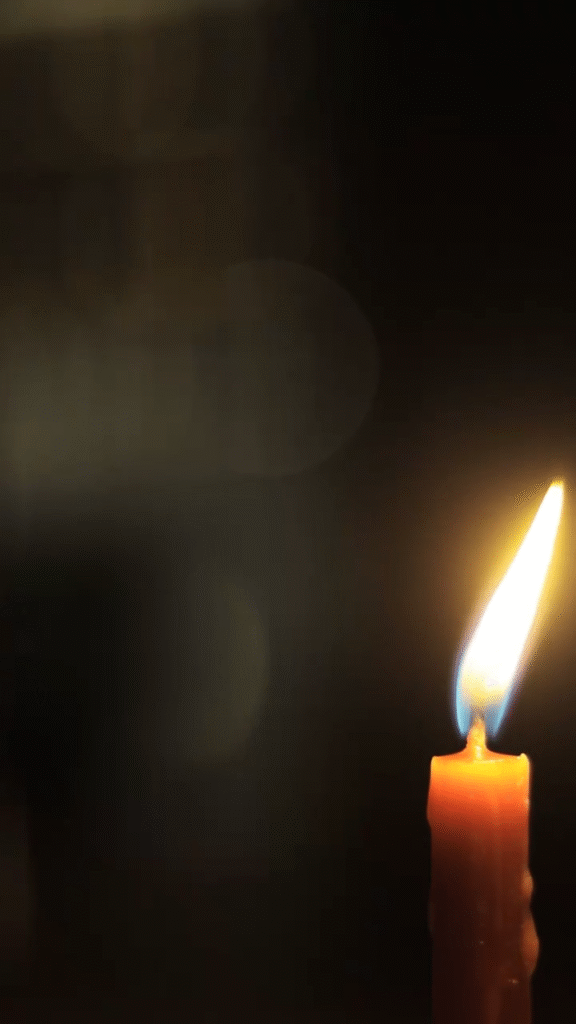
Candle : A candle flame has a shape. You can draw it. It is there. And yet there is no thing there — the matter passing through it is renewed a thousand times a second, the carbon burning off, the air rushing in, the whole form persisting precisely because nothing in it stays. Stop the flow and you do not get a stable flame. You get no flame. This is the first law of anti-structure that the engineers cannot accept, because their entire training is the opposite: the form exists only as long as it is being destroyed and remade.Permanence, for such a thing, is death. Motion is the only load-bearing element.
Language : A language has no fence, only a shoreline — a boundary that’s real and that no one drew. It isn’t permanent, and that’s not its weakness but its pulse; the day it stops changing is the day it dies. It lives nowhere you can point — not in the dictionary, which is only its photograph, not in any single brain, which holds only a fragment — but in the space between speakers, the way a conversation lives in neither mouth but in the agreement between them. It’s bent by enormous forces, none of which command it. And it’s invisible not because it’s faint but because you’re looking through it. It is soaked in structure — and every rule of it was authored by no one.
“Our minds can own structure; they cannot own anti-structure.” Yes — and here’s why, which makes it stronger. To own something, you have to be able to hold all of it, to stand outside it and grasp it whole. You can do that with a structure because a structure has an edge and a bottom; you can get around it. But anti-structure has no outside to stand on and no bottom to reach — it’s the water you’re swimming in, not the fish you can catch. You can’t own your language because you think in it; you can’t own the market because your belief is part of it; you can’t own your fame because it lives in heads that aren’t yours. The moment a thing has no floor and no author, ownership becomes a category error. You don’t possess it. At most, you participate in it — and participation is the opposite of ownership, because the instant you stop, it goes on without you.
“Structured things can be created; unstructured things can only be realised.” This is the line I’d build the whole essay around, because that word — realised — is doing something exact. You create a structure: you author it, you impose it, it wasn’t there and now it is, and it bears your fingerprints. But you cannot create a flame’s shape, a market’s price, a language, a prime. Those you can only realise — in the old double sense of the word, which is the sweet spot: you make them real (you supply the conditions and let them come) and you come to realise them (you notice something that was already the case). The prime was going to be prime whether or not you found it. The song was true before you wrote it down. Creation is addition — you put something into the world. Realisation is recognition — you catch something the world was already doing. The engineer creates. The discoverer, the poet, the mystic, the mathematician can only realise. And that’s why the second kind of thing never feels like yours: because it wasn’t. You found it. You didn’t make it.
“A song that touches your heart has structure, but the structure doesn’t make it a song.” This is the cleanest kill in your whole paragraph, so don’t rush past it. You can write out every structural fact about a song — the notes, the intervals, the tempo, the waveform, the frequencies in hertz — and you will have described it completely and captured nothing. The sheet music is not the song. The spectrogram is not the song. All the structure is present and the thing itself has escaped, because the song isn’t in the notes — it’s in what happens between the notes and a listener, in the space where a pattern of air becomes grief or joy in a body that no equation reached. The structure is the wax. The song is the flame. And here’s the proof buried in your own sentence: two people hear the identical structure and one weeps while the other shrugs. If the structure were the song, that couldn’t happen. The song lives on the far side of the structure, in a place the structure can point toward but never contain.
“Your body has structure — but even a dead body has structure, and it is not alive.” And this is the one that turns the whole thing from clever to true, because it makes the distinction impossible to wave away. A corpse has everythingstructural the living body had — the same bones, the same organs, the same architecture down to the cell, more intact in the first hour than it will ever be again. Every structural fact is still there. And the one thing that matters is gone. So whatever life is, it is provably not a structural property — you can hold the entire structure in your hands and life will not be among its features. Life was never a part of the body. It was something the parts were doing — a process, a flame, a verb — and when the doing stopped, every noun remained and the thing died. This is the final form of your whole argument: structure is what’s left when the anti-structure leaves. The corpse is the building. The life was the fire in it. And no examination of the building, however total, will ever locate the fire, because the fire was never a thing in the building — it was the building, burning.
Anti-structure is easy to miss because the mind is a structure-detector — it was built to catch edges and parts, and it slides off the essence the way a hand slides off water. So we spend ourselves deconstructing everything into its pieces, mistaking the taking-apart for understanding, and we live inside the great illusion that a thing is the sum of its parts. It isn’t — the corpse has every part and no life; the song has every note and touches no one. And this is why AI, for all its wonder, is structure and not essence. It is emergent, yes — but emergent from a frozen past, a photograph of everything we have collectively said, crystallised the moment the training stopped. The living things — language, markets, minds — are burning in the present tense, re-founding themselves each instant. The model is the ash of that fire, pressed into a diamond. It can exceed us in degree and never step outside us in kind, because it has no flame of its own — only the perfect, still shape of where our flames have already been.